
Lesson 10 of 14 · Part 3 of 6
"The market is down, let's wait"
Waiting is a choice too. Show the income in dollars if the market rises, stays flat or falls, with the client's own numbers.
Do it in Genius
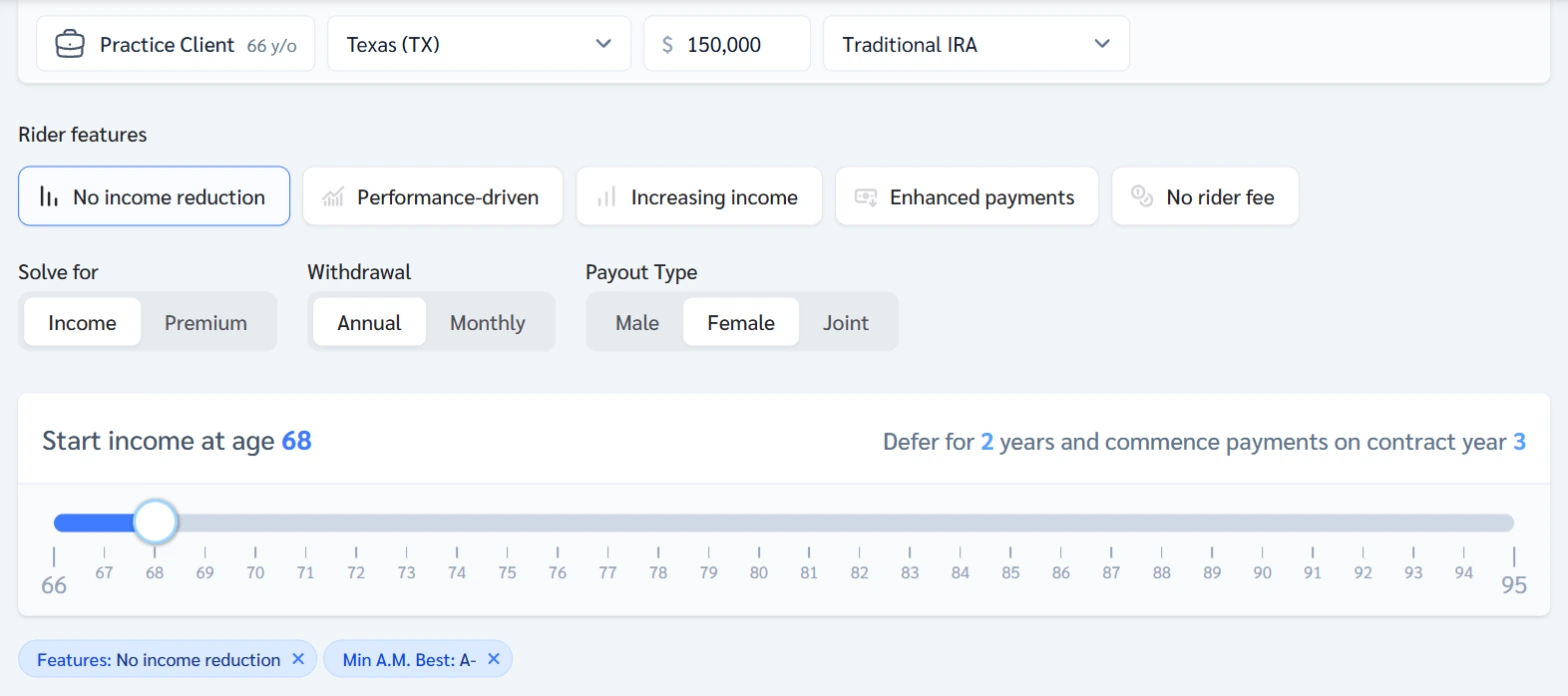
Income rider calculator Start income at age
Practice Client, 3 Nov 2026: the top bar shows $150,000. The slider reads "Start income at age 68" and "Defer for 2 years".
Rates change every day, so yours will differ.
Open Income rider calculator in Genius (opens the app in a new tab)In the app: Calculators → Income rider calculator
 (opens full size in a new tab)
-
1.
Example: $150,000 planned, $135,000 after a fall. At a 7.5% payout on the balance, income is $11,250 or $10,125: $1,125 less a year.
- Benefit base
- The number the insurer uses to work out income. It is not cash and not the account value.
Real rows differ. The $15,000 fall already costs $1,125 a year. Waiting can win it back or lose more.
-
2.
Open Calculators, then Income rider calculator. Run three balances: $135,000 now, $150,000 if it recovers, $120,000 if it falls again. Write all three down.
Buying now is not income now: the Start income at age slider sets the start.
-
3.
Write them as three markets from $135,000: up $15,000 pays $11,250 a year, flat $10,125, down $15,000 $9,000.
Same three runs, with the 7.5% example rule. Buying now pays $10,125. Ask which of the three the client can live with.
-
4.
Ask the insurer for its written rate-lock rules and funding deadline. Never assume the application date locks a rate.
Ask for the written rules first. A client who sees both costs in dollars can decide at the table.