
Lesson 11 of 16 · Page 3 of 4
Which money pays: the tax side
The same income is taxed differently depending on where the money comes from. Genius asks for it in the SPIA calculator and on the client's form.
Do it in Genius
SPIA calculator Premium & Income Source of Funds
Practice Client, 12 Nov 2026: Source of Funds offers Traditional IRA, Non-qualified, Roth IRA and more. Her IRA is $150,000.
Rates change every day, so yours will differ.
Open SPIA calculator in Genius (opens the app in a new tab)In the app: Calculators → SPIA calculator
-
1.
Open SPIA calculator. Under Premium & Income, set Source of Funds to where the client's money comes from.
Practice Client: Traditional IRA, $150,000. The client's form asks it too, as Funding Source.
-
2.
Traditional IRA or 401(k): payments are generally ordinary income. Only a QLAC (longevity annuity) can stay out of the RMD balance until it pays.
- QLAC
- A longevity annuity that meets Treasury rules. Its value can be left out of the RMD balance until payments begin.
After Get quotes: Taxable Portion says Fully taxable on Traditional IRA money, and Monthly Taxable lists each quote.
-
3.
Pick Non-qualified: part of each payment is the client's own money back, untaxed. Tick the 1035 box for money from an older annuity.
- Exclusion ratio
- The share of each payment that is the client's money back. Tax-free until the cost is recovered.
- 1035 exchange
- A tax-deferred swap of an annuity or life policy for a new annuity. Cash paid to the owner can make it taxable.
A rider on that money is different: withdrawals are taxed gain first, until only the client's money is left.
-
4.
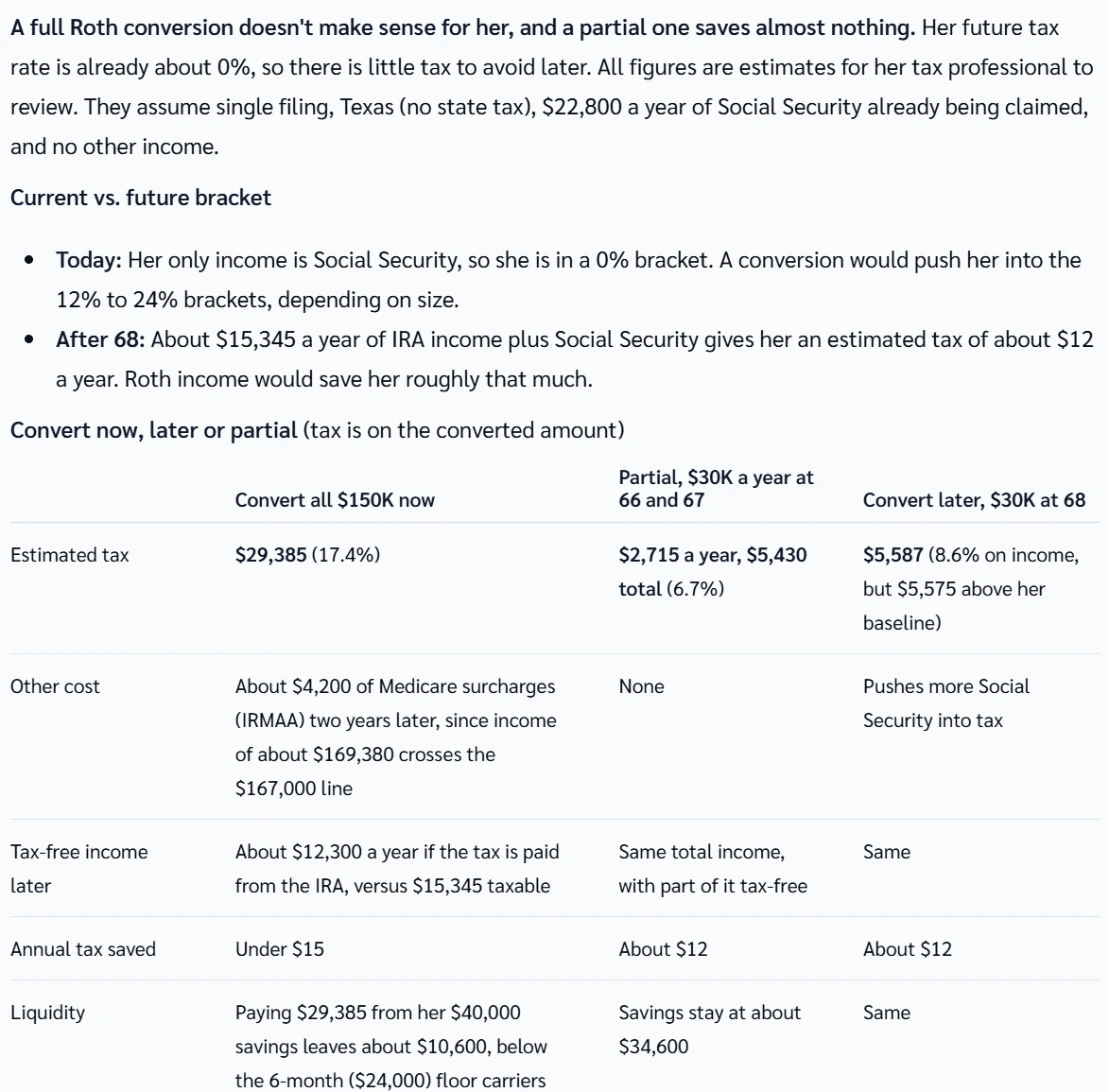
Before choosing the account, ask GrantAI to compare a Roth conversion. Roth Conversion is its own Funding Source.
- Roth
- Retirement money taxed going in. It can come out tax-free under the rules.
Compare converting to a Roth now or later for this client. Show the estimated tax and other costs.
Select the text and copy it.
Full conversion on the Practice Client: about $29,385 in tax, 17.4% of that year's income of about $169,380. GrantAI says it doesn't make sense for her.
 (opens full size in a new tab)
Sources
- IRS Publication 575: pension and annuity income
- IRS Publication 939: general rule for annuities
- IRS Publication 590-B: IRA distributions
- IRS: Required minimum distributions
- Annuities Genius help: Qualified vs Non-Qualified Funds
- Annuities Genius help: Create a Client Case
- IRS: Roth IRAs
- 26 U.S.C. 1035: exchanges of annuities
- Annuities Genius app, checked 3, 10 and 12 Nov 2026
- 26 U.S.C. 72: taxation of annuities
- Treasury rule: a QLAC is left out of the RMD balance, 26 CFR 1.401(a)(9)-5(b)(4)