
Income for life from an FIA: the income rider
An income rider is a benefit on an FIA, optional or built in, that pays an income for life. The money stays in the client's account, and the income is paid out of it first.
In Genius: Calculators Income rider calculator Solve for Start income at age Rider features
Open in Genius (opens the app in a new tab)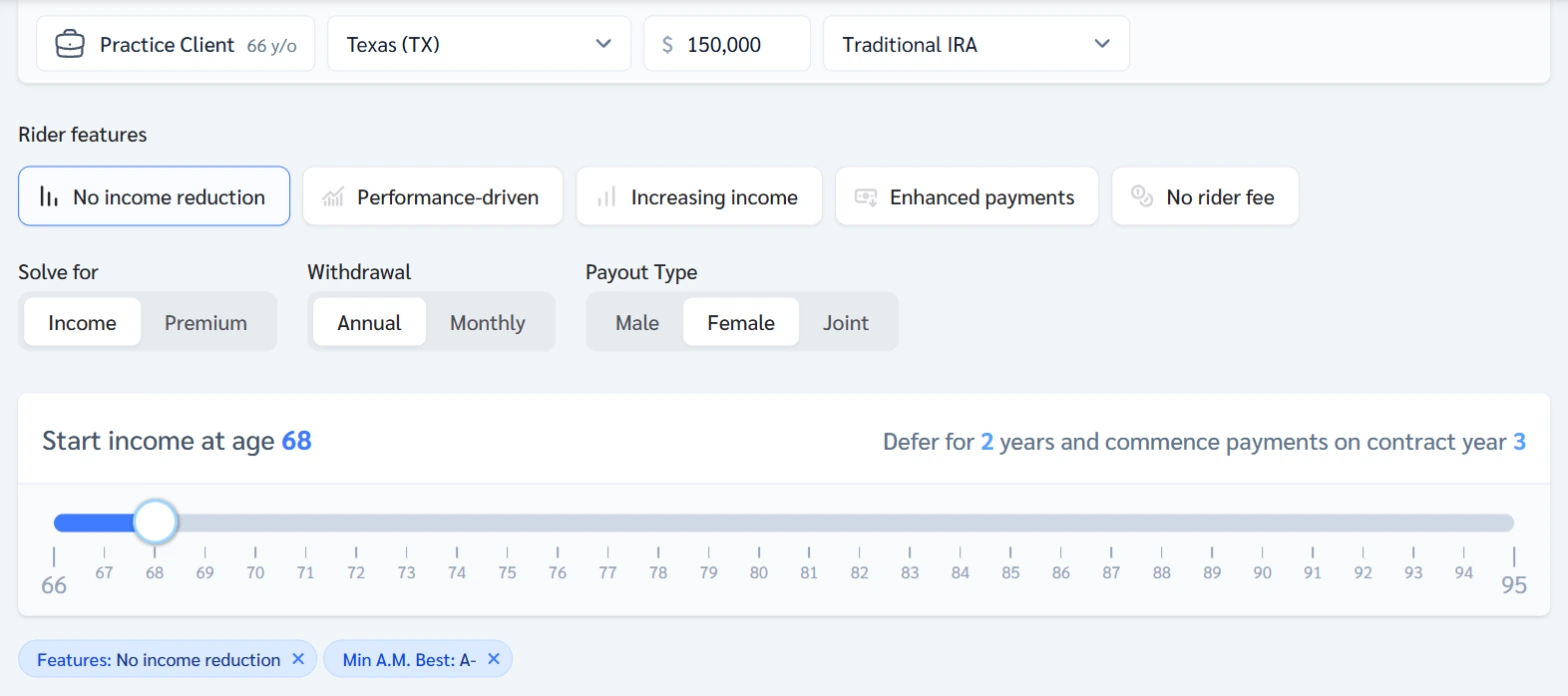 (opens full size in a new tab)
You should see: For the Practice Client (66, Texas, $150,000 IRA, income from 68), the first row you can sell pays $15,030 a year, $1,253 a month. Rates change every day, so yours will differ.
-
1.
A client says "I want income I can't outlive, but I don't want to give up the money." That points to an FIA with an income rider.
- The sum
- A SPIA turns it into payments, and it usually can't come back. With a rider it stays in the client's account, and the income is paid out of it.
- When income starts
- A SPIA pays soon after the client pays in. A rider pays from the age the client picks, often years later.
- If they die early
- A SPIA follows its Payout Option, and Life Only leaves nothing to the family. With a rider, what is left in the account, if any, usually goes to the people they name.
- Cost
- A SPIA's cost is built into the payout. A rider usually has a yearly charge.
-
2.
Income is the benefit base times the payout percentage. Learn both before you quote.
- Benefit base
- Also income base: the number income is worked out from. Not cash, not the account value.
- Payout percentage
- Withdrawal Percentage in Genius: the factor the contract applies to the benefit base to get yearly income. It follows age at first withdrawal and single or joint cover.
-
3.
Open Income rider calculator. Set Solve for to Income and Payout Type to match the client, drag Start income at age to 68, and click No income reduction.
Skip rows marked Fee-based or Income can decrease. That leaves $15,030 a year as the top row for the Practice Client. By the price list, running a quote uses 15 credits.
-
4.
Tell them: "The income comes out of your own account first. If the account runs out, the insurer keeps paying, as long as you stay within the rider's rules."
On this row the rider charge is 1.3% of the benefit base, about $1,950 a year. Taking out more than the rider allows lowers the income that follows and can end it. With no growth the Practice Client's account is $0 by 77, and the table still lists $15,030 a year to age 95.