
Lesson 10 of 14 · Part 4 of 6
"Average return" is not what you get: order matters
A client who trusts averages needs one table. Show that the same returns, in a different order, end far apart when money comes out.
Do it in Genius
All cases your client Calculators Simulator Market model: Worst 20 years Add Scenario
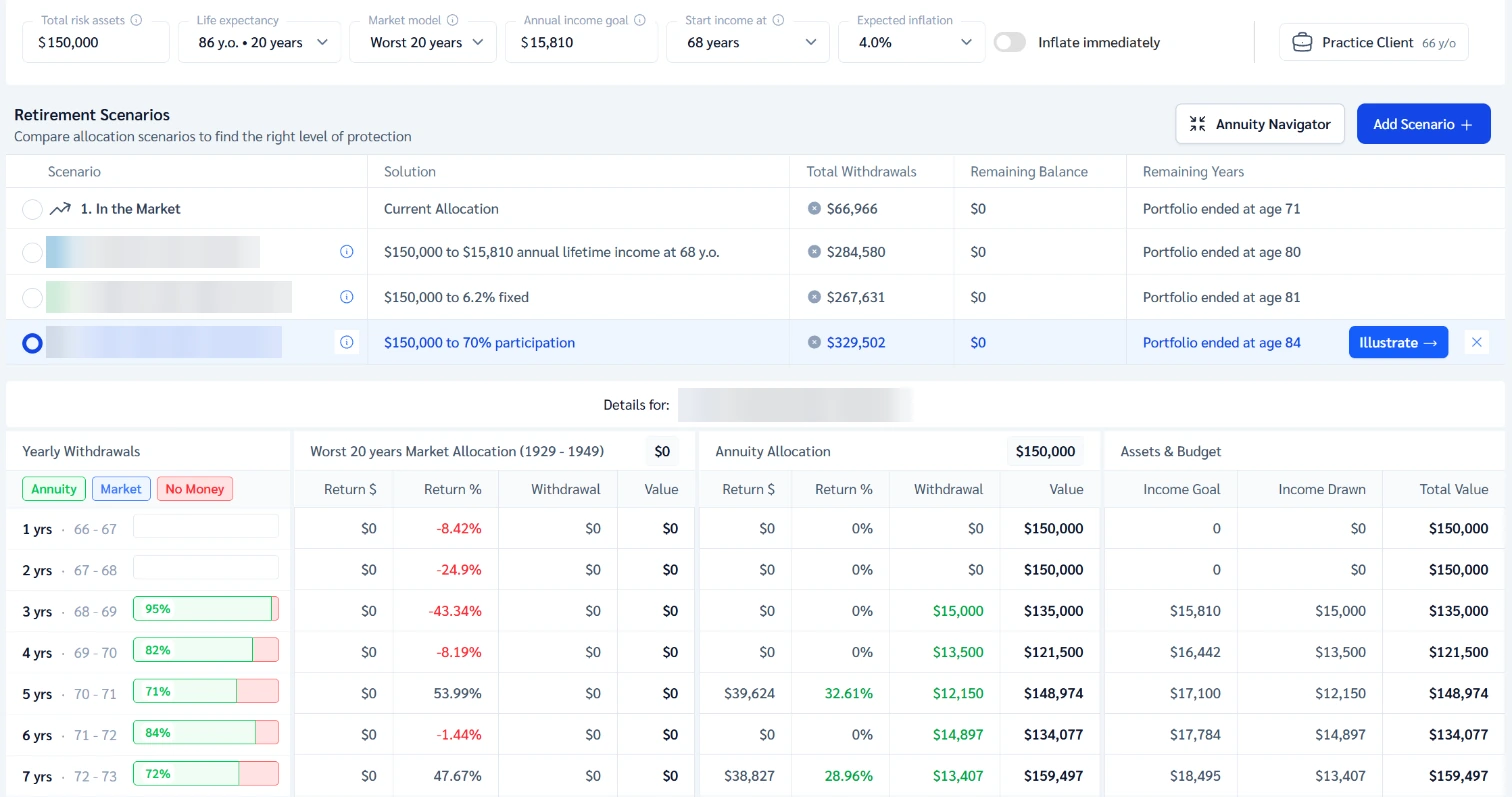
Practice Client, 3 Nov 2026: Worst 20 years, the market paid $66,966 and ran out at 71. Fixed Interest paid $267,631, Index-Linked Growth $329,502.
Rates change every day, so yours will differ.
Open your clients in Genius (opens the app in a new tab)In the app: CRM → All cases
 (opens full size in a new tab)
-
1.
A 10% loss needs an 11% gain to recover. A 20% loss needs 25%, 30% needs 43%, 40% needs 67%, 50% needs 100%.
-
2.
Two retirees start with $1,000,000 and take $60,000 at the start of each year. Same six returns, opposite order.
Returns in order: -20%, -10%, +5%, +10%, +15%, +20%. The average is about 3.3%.
-
3.
Bad years first: about $651,000 is left after six years. Good years first: about $835,000. Same average, about $184,000 apart.
Why: the $60,000 comes out each year. With no withdrawals, the order changes nothing.
-
4.
In Simulator, set Market model to Worst 20 years. Add Scenario: Fixed Interest, then Index-Linked Growth. Each time, click Simulate on your pick.
Client asks: "Fixed shows 6.2%. Why an index?" Show $267,631 beside $329,502 as a past replay, not a forecast. Index interest can be 0% in a bad year.