
Lesson 4 of 14 · Part 1 of 4
Read the rider: base, fee, doubler
Every income-rider row rests on a benefit base and a payout percentage set by the contract. Find both, then any rider charge and what it is charged on.
Do it in Genius
Income rider calculator row ⋮ Annuity info Riders
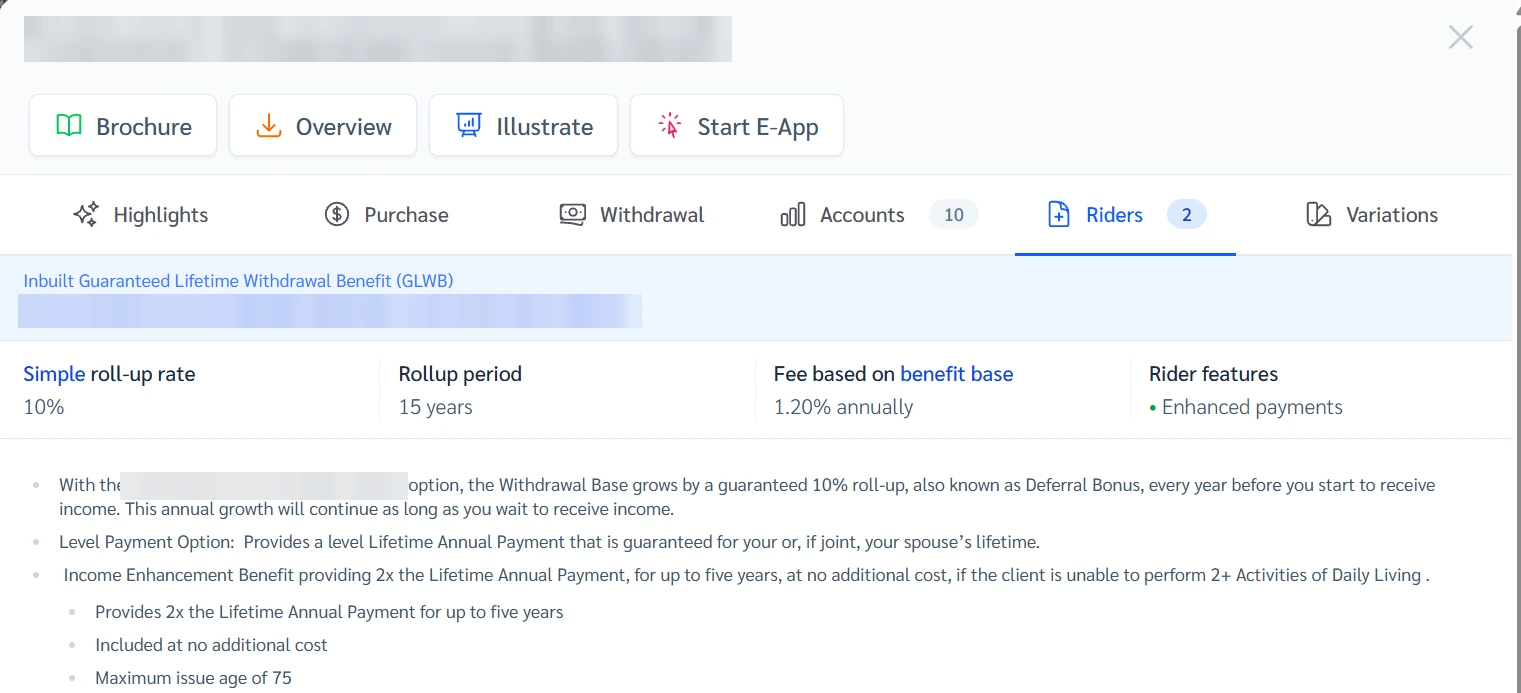
Practice Client, 3 Nov 2026: one rider card says "Fee based on benefit base: 1.20% annually" and a simple 10% roll-up.
Rates change every day, so yours will differ.
Open Income rider calculator in Genius (opens the app in a new tab)In the app: Calculators → Income rider calculator
 (opens full size in a new tab)
-
1.
On any row, click the three dots, then Annuity info, then Riders.
- Doubler
- Pays double income for a set time if the client cannot do daily tasks such as bathing or dressing. It is not long-term care insurance.
Example: Enhanced payments double income for up to 5 years if the client cannot do 2 or more daily activities. That is the doubler. Read the conditions.
-
2.
Find the fee line, here Fee based on benefit base. Note the percent and what it is charged on.
- Rider charge
- Usually a yearly charge for the income rider. It can be a percent of the benefit base, the account or the premium.
- Benefit Base
- Also income base. The number the income is worked out from. Not cash the client can take.
1.20% a year of the base, not the deposit. For dollars, multiply by the same row's base in step 4.
-
3.
Income is the benefit base times the payout percentage. The roll-up grows only the base. Step 4 shows both.
- Roll-up
- How fast the benefit base grows while the client waits. It is not money the client earns.
- Withdrawal Percentage
- Also called the payout percentage: the factor the contract applies to the benefit base to get yearly income. It follows age at first withdrawal and single or joint cover.
The payout percentage is not the roll-up rate. The app shows a simple roll-up here. Compound? Check the contract.
-
4.
Click the three dots again and open Deferral snapshot. Read the base times the Withdrawal Percentage, not the Income/Premium Ratio.
Example from the unfiltered list: a $213,000 base times a 10.60% withdrawal percentage is $22,578 a year at 70. The percentage steps up with age.